
On the road up from the plains, the mountain changes faster than the weather. In a single drive the route climbs more than two kilometres, from warm forest where hornbills feed on fruit to a ridge wrapped in cloud, where owls sleep in bamboo and partridges walk on moss. Over three days, from 2 to 4 October 2026, we worked the same slope again and again, at dawn, at midday and in the last light. This is a portrait of that slope: what grows at each height, what lives there, and who has made a home on it.
Three days on one mountain gave 41 species of birds and two squirrels. Because we kept returning to the same places, this account is arranged by place rather than by day.
The birds of the trip
Picked by us, in our order.
- 1
Himalayan Owl Strix nivicolum
Asleep on a mossy branch deep in the bamboo and cedar of Senchal, and quite unbothered by us. More below.

- 2
Red Crossbill Loxia curvirostra
A pair on a dead snag above Lepchajagat at dawn: the brick-red male and the olive female, both with the crossed bill tips that let them prise seeds from cones. More below.

- 3
Brown Parrotbill Cholornis unicolor
A plain brown bird with a stubby yellow bill like a small parrot's, built for crushing bamboo shoots and seeds. It lives inside high-altitude bamboo and is rarely seen in the open.

- 4
Eurasian Hobby Falco subbuteo
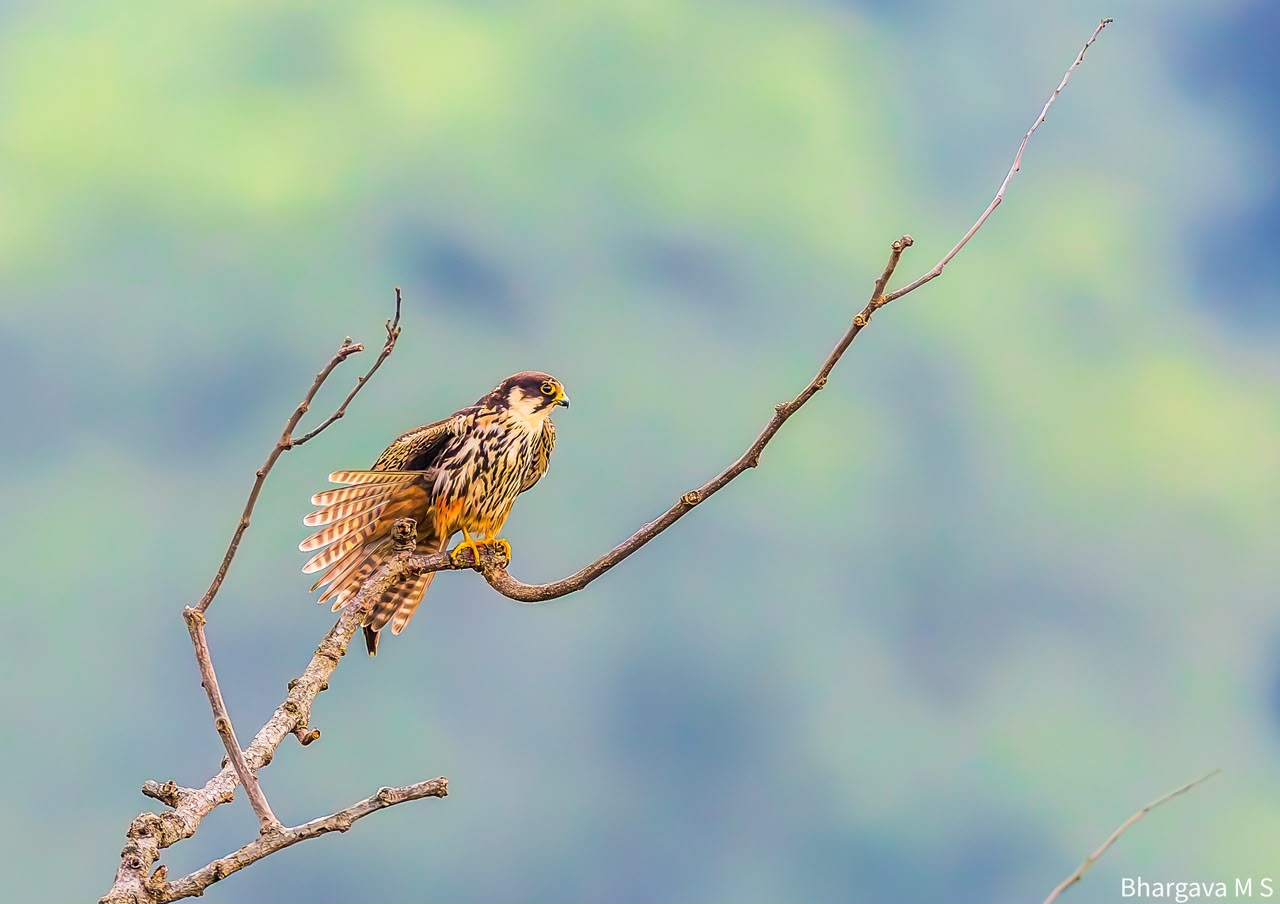
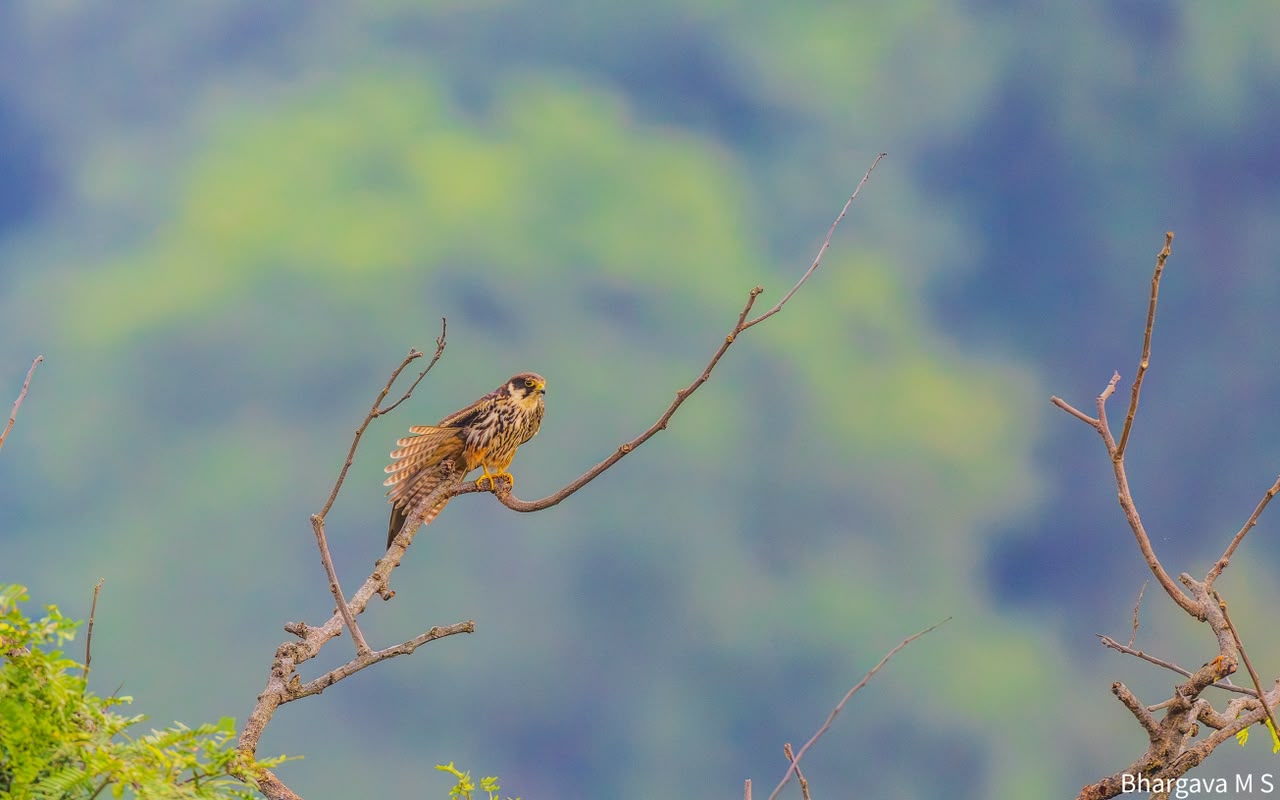
A young falcon on a bare branch, streaked below, with a dark moustache. Hobbies are fast enough to catch swifts and dragonflies in the air, and many pass through these hills on migration in autumn.

- 5
Thick-billed Green Pigeon Treron curvirostra
A male in a fruiting tree, green with a grey crown and a maroon back, eating small orange fruit. Green pigeons are as much a part of the fruit economy of the lower forest as the hornbills are.

Birds, a closer look
Ten photographs by Bhargava Marur, from the Darjeeling hills. Full frames, with his watermark kept intact.
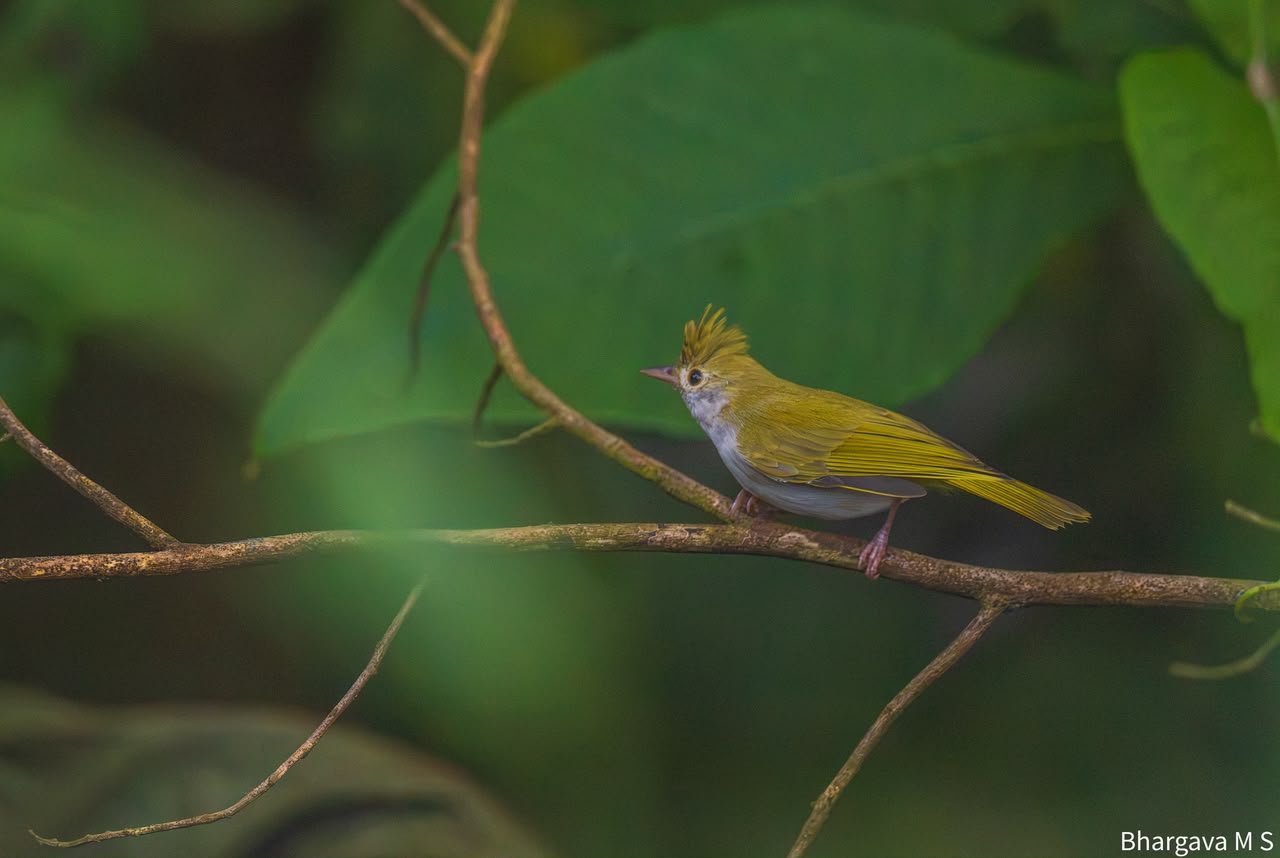
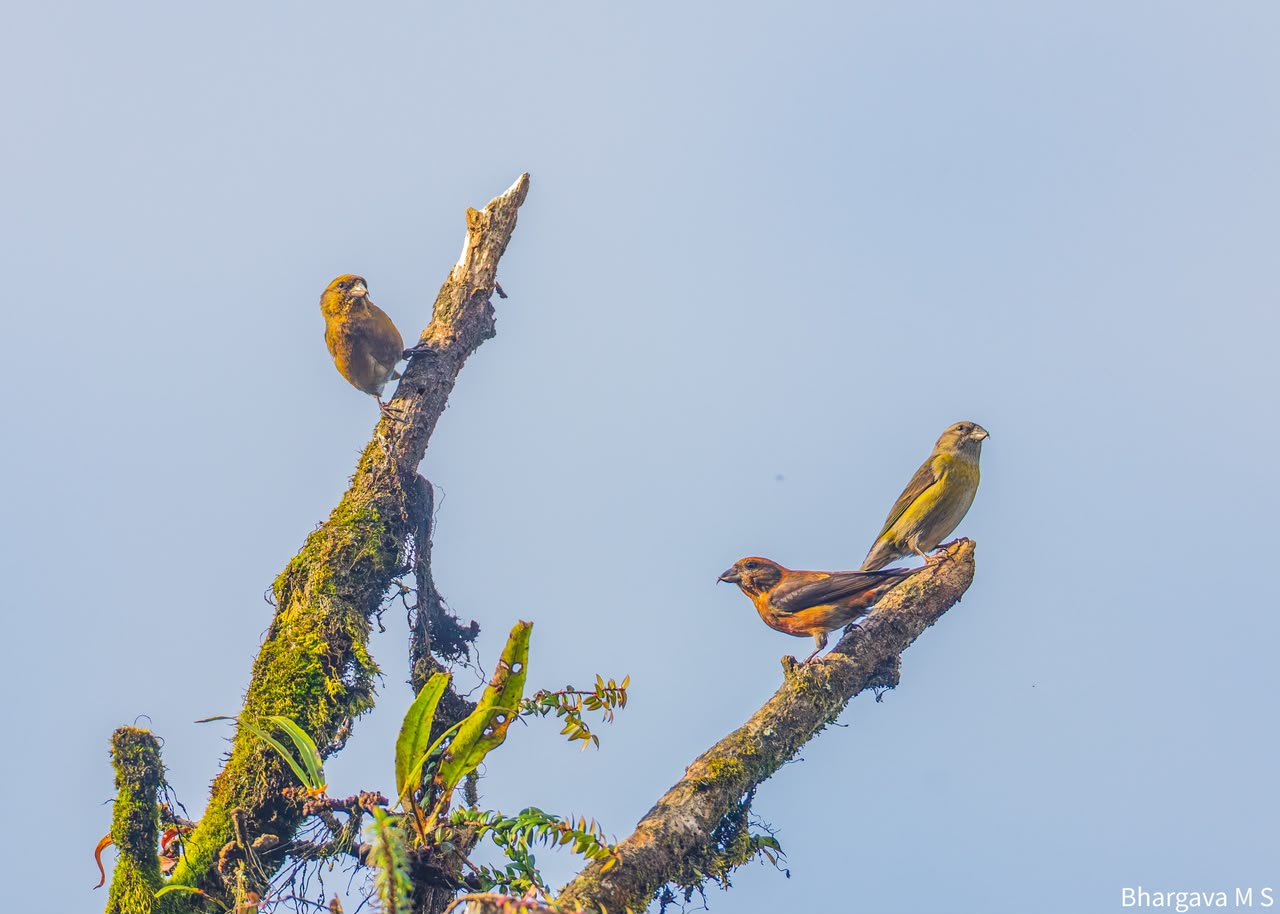
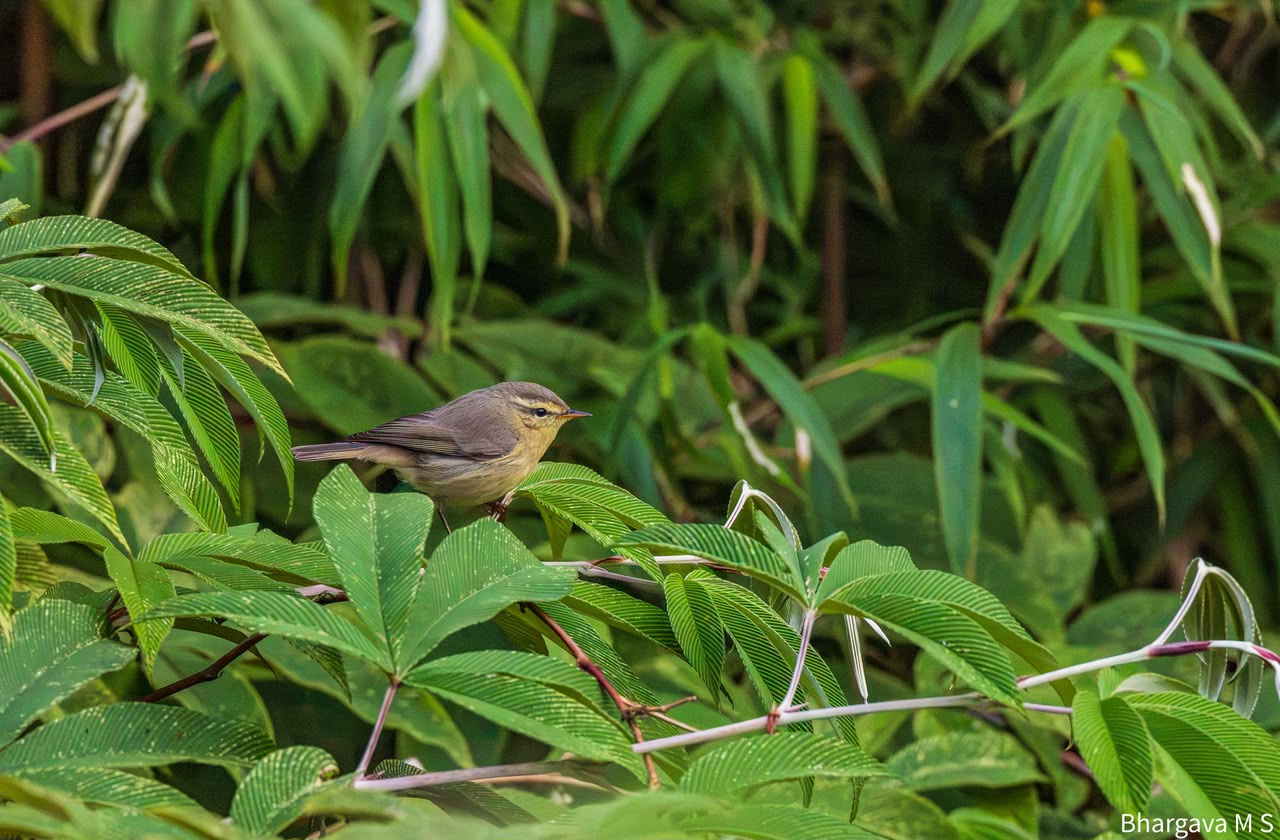
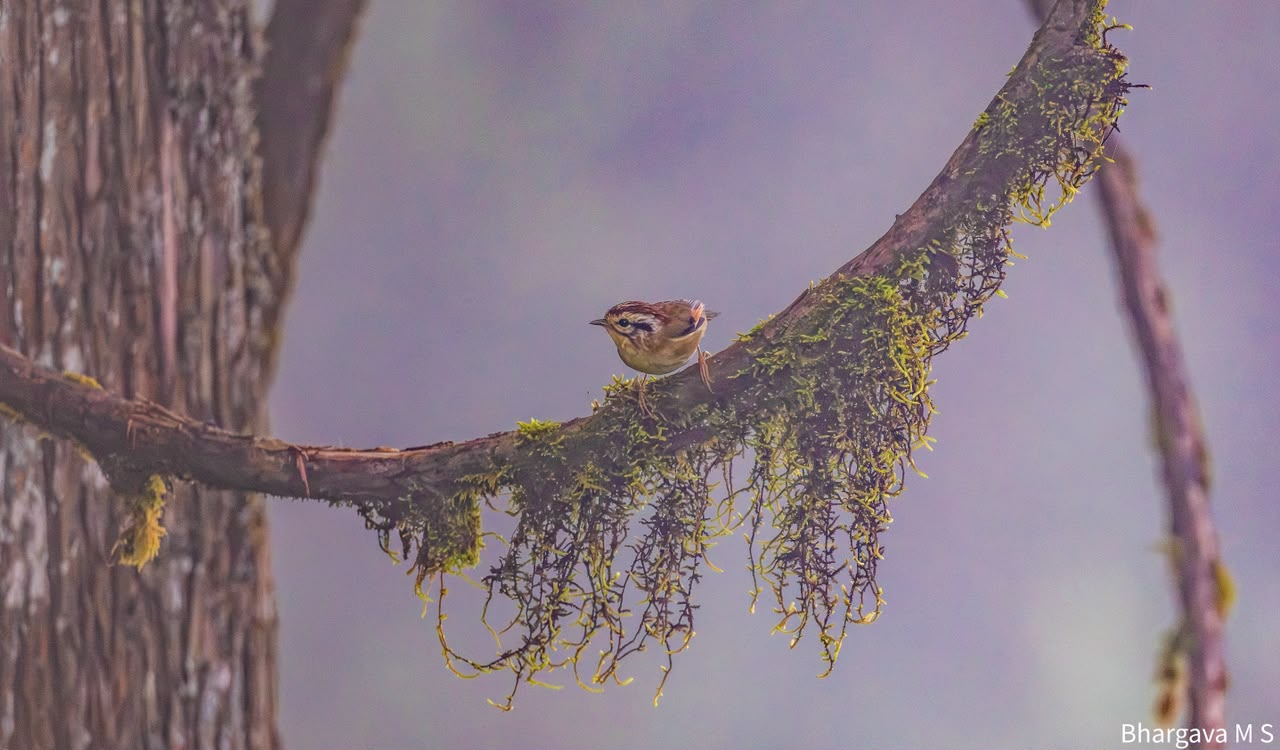
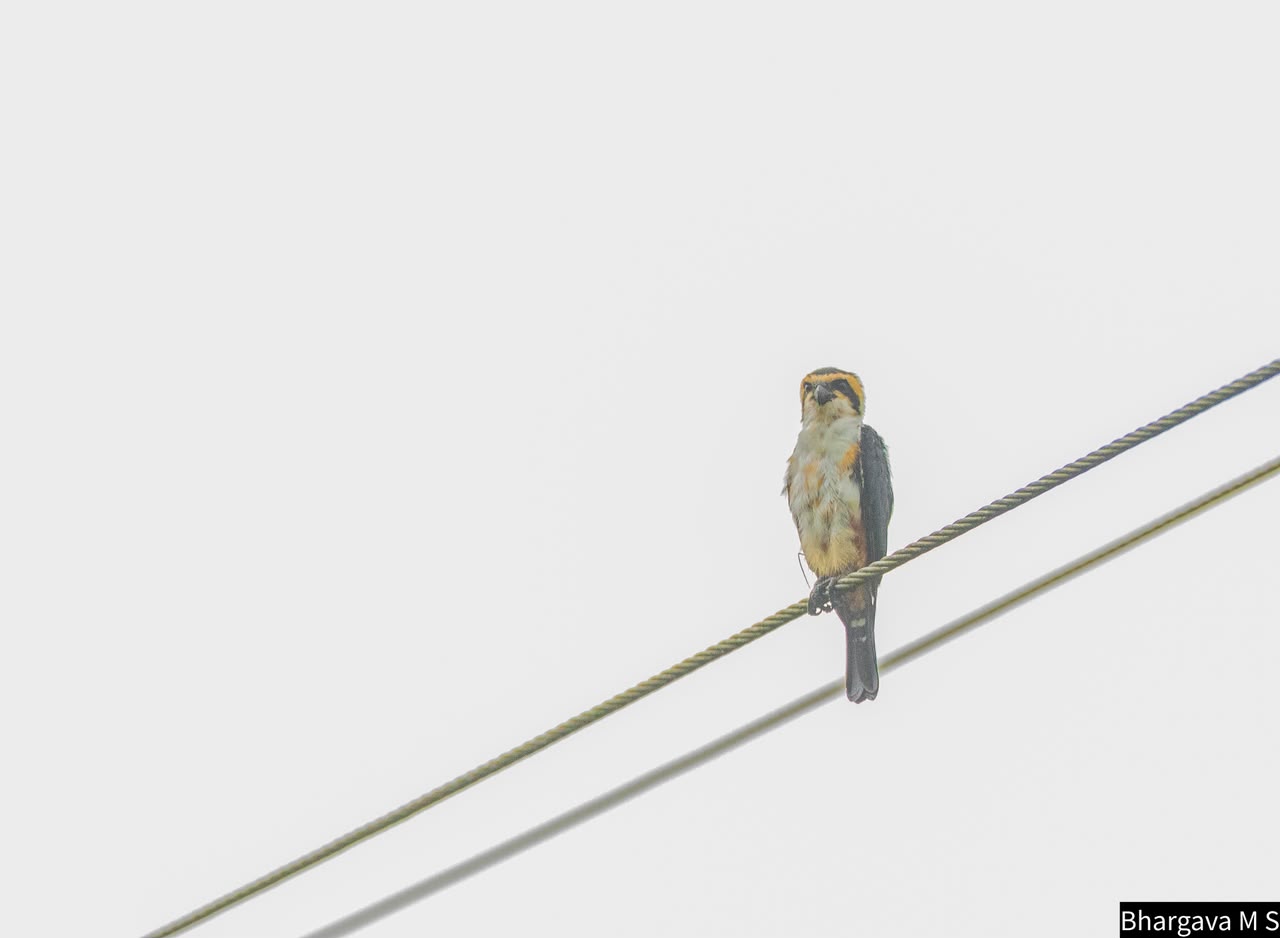
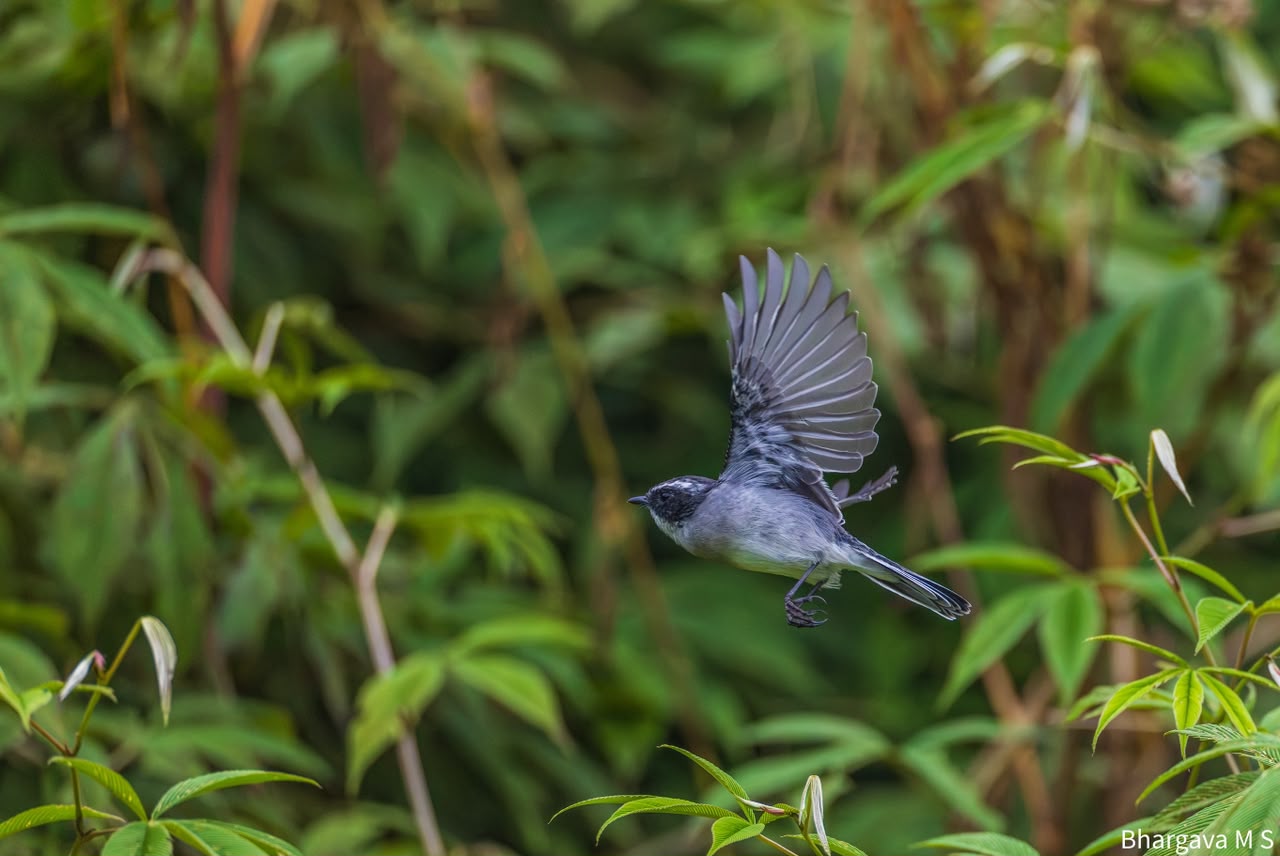
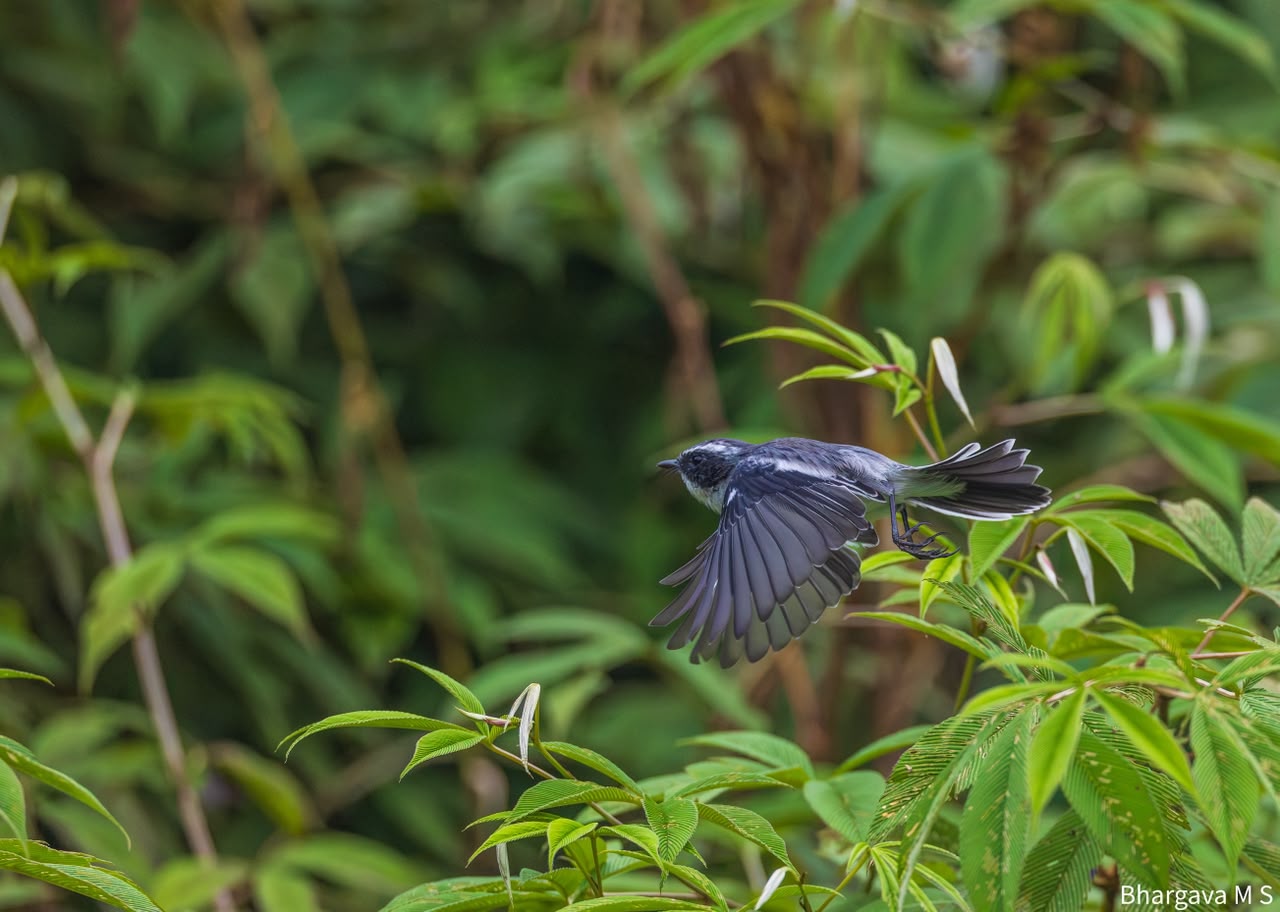
The bush warbler is provisionally identified as Aberrant Bush Warbler, following the field identification in the story. Similar bush warblers are difficult to separate from a photograph alone.
Rongtong
The name is usually translated as “southern river”.
Rongtong is where the Darjeeling Himalayan Railway, the toy train listed as a UNESCO World Heritage Site, starts its real climb. Below it lie the plains of Siliguri. Above it the hills begin to fold, and the forest is still warm, broad-leaved and full of fruit.
Fruiting trees set the rhythm of life at this height. When one ripens, it pulls in the big fruit-eaters from across the valley, and everything else follows: mynas, squirrels, and the insects that feed the hunters perched above them.

The Great Hornbill is the giant of these forests, and it depends on them more than almost any other bird. It feeds largely on fruit, especially figs, and swallows the seeds whole, carrying them far from the parent tree. Forests that lose their hornbills slowly lose the trees that rely on them to spread. The species is listed as Vulnerable, mainly because of hunting and the loss of the big old trees it needs for nesting.
Others of the lower forest
Tap a card to read about each one.

Common Hill Myna
Gracula religiosa
Oriental Dollarbird
Eurystomus orientalis
Asian Barred Owlet
Glaucidium cuculoides
Black Giant Squirrel
Ratufa bicolorThe rest of the warm forest
Over the three days, the lower slopes gave many of the birds on the trip list. They belong to warm, broad-leaved forest, and most of them depend on fruit or on the insects that fruiting trees attract.
Three kinds of green pigeon feed in these canopies: Pin-tailed, Wedge-tailed and Thick-billed. They are green to match the leaves and very hard to see until they move. Maroon and Black-hooded Orioles, the Orange-bellied Leafbird, Blue-throated Barbet, Lesser Yellownape, a woodpecker, and the long-tailed Green-billed Malkoha all work the same trees.

Two cuckoos were on the list, the Indian Cuckoo and the Asian Emerald Cuckoo. The Indian Cuckoo is far more often heard than seen: its four-note call carries across these valleys in spring, and by October the birds are quiet. Above them hunted two falcons at the opposite ends of the size scale: the Eurasian Hobby, and the Collared Falconet, one of the smallest birds of prey in the world, not much bigger than a sparrow. It perches on bare treetops and drops onto large insects.
Rangbull
A small settlement on the way up toward Senchal.
Somewhere on the climb, the warm forest gives way. The air cools, moss starts to thicken on the branches, and the birds become smaller, browner and harder to see. They move in restless mixed flocks through the undergrowth, and most of what you find, you find by ear first.

The Rufous-winged Fulvetta (Pseudominla castaneceps) is a tiny babbler of mossy forest, with a streaked crown, a pale stripe over the eye and a rufous-and-black panel on the wing.
Fulvettas rarely sit still. They creep over mossy branches and trunks in busy little groups, often mixed with warblers and tits.
Senchal and Tiger Hill
A sanctuary since 1915, and a source of Darjeeling's drinking water.

Senchal Wildlife Sanctuary was set up in 1915, which makes it one of the oldest protected areas in India. It stretches from about 1,500 metres to more than 2,600, and its forests feed the streams and lakes that supply water to Darjeeling town. Tiger Hill, famous for its sunrise view of Kangchenjunga, sits inside it.

The sanctuary's entry ticket carries two rules on its face: no drones, and no plastic.
The forest by height
The forest here is layered by altitude, and more than half of it was planted by people. Tap a layer to read more.


The owl in the bamboo
By day the Himalayan Owl does almost nothing, and that is its defence. It sits pressed against a mossy branch in the darkest part of a thicket, its mottled brown and rufous plumage breaking up its outline, and waits for the night. A round head with no ear tufts, large dark eyes and a scaly breast set it apart from the other owls of these hills.
The exact roost is not given here. Owls often return to the same roost day after day, and a precise location can draw a stream of visitors that keep flushing the bird.
Can you find the bird?
Birds in this forest are rarely out in the open. Somewhere in this bamboo there is a bird sitting still. Tap where you think it is.

It is an Oriental Turtle Dove (Streptopelia orientalis), the dove of Himalayan forest, with a grey crown and wing feathers scalloped in black and rufous. Even a bird this size vanishes into bamboo once it stops moving.
The feeding log
Near Tiger Hill Pavilion, grain is put out along a fallen log, and the shy ground birds of the forest come to it in the late afternoon. Feeding sites like this make it possible to see birds that are otherwise almost always just a call in the undergrowth. Tap each number to see who came. On a phone, swipe the photo sideways to see the whole log.

Six animals of three species on one log.

The Hill Partridge (Arborophila torqueola) lives on the forest floor and is far more often heard than seen: its whistled call, repeated and rising, carries through the oak forest at dawn. Males wear a chestnut cap and a black-and-white face. Females are plainer, with a rufous-brown head. Both are spotted and barred on the flanks to match the leaf litter.

The Spotted Laughingthrush (Ianthocincla ocellata) is one of the largest and most handsome of the laughingthrushes: a chestnut back covered in white spots, a black-and-white barred breast and an orange face. It keeps to dense undergrowth, and came out only for the grain.
Smaller lives of the cloud forest
Aberrant Bush Warbler
Horornis flavolivaceus
Orange-bellied Himalayan Squirrel
Dremomys lokriahThe British on the ridge
Long before it was a sanctuary, Senchal was a British hill post, at about 8,600 feet, a few miles from Darjeeling. Barracks stood on the hilltop by the early 1860s; a photograph attributed to Sir Benjamin Simpson, dated to about 1862 and now in the J. Paul Getty Museum, shows a cluster of long buildings along the summit.
The climate that makes the ridge so rich for moss and owls made it hard for soldiers. Ruins of colonial-era buildings still stand near the trail today, with fireplaces and chimneys open to the cloud.
Flags in the wind
Around Tiger Hill, thousands of Buddhist prayer flags hang between the trees. They come in five colours in a fixed order, each standing for an element: blue for sky, white for air, red for fire, green for water and yellow for earth. The idea is that the wind carries the prayers printed on them out across the land, and old strings are left to fade and fray as new ones are added.
Close by, a sign asks visitors, simply, “No prayer flags please”. The sign does not say why, and the flags keep coming. The two stand a few steps apart.

Lepchajagat
“Jagat” means world: the world of the Lepchas.
The day ends a little lower, in a forest hamlet on the road from Ghum toward Mirik. Lepchajagat takes its name from the Lepcha, the indigenous people of the Darjeeling and Sikkim hills, who first settled here.
It is a village of a single street, strung along the road under oak, rhododendron and pine. Family-run homestays line it, and the Nepal border is close: the market town of Pashupati, just across it, is about half an hour's drive away.

“There are only about thirty houses here.”
At night the cloud comes down through the trees and the village goes quiet. In the forest around it, the owls of the cloud forest are just waking up.
Dawn on the doorstep
Lepchajagat sits right in the forest, so the birding starts at the door. On the morning of 3 October we walked out at about six, under low cloud with mist lying in the valleys and dew on everything, and kept going for four hours.

The forest above the village is the same mix as at Senchal: planted dhupi cedar over a dense understorey of bamboo. The cedar is not native to the Himalaya, but one bird here depends on it.
The Red Crossbill feeds almost entirely on conifer seeds. The crossed tips of its bill work like a lever: it pushes them between the scales of a cone, twists, and lifts out the seed with its tongue. Crossbills wander wherever the cone crop is good, so they can be common in a place one year and absent the next. Finding a pair at dawn, sitting still in the open, was the best moment of the morning.

The bamboo edge
Where the bamboo meets the road, the birds come out. Small flocks of Black-throated Parrotbills, four together, moved through the stems, tiny orange-headed birds that live almost entirely in bamboo. An Aberrant Bush Warbler called from inside the thicket, and a Barred Cuckoo-Dove, a long-tailed forest dove barred all over, sat quietly in the canopy.


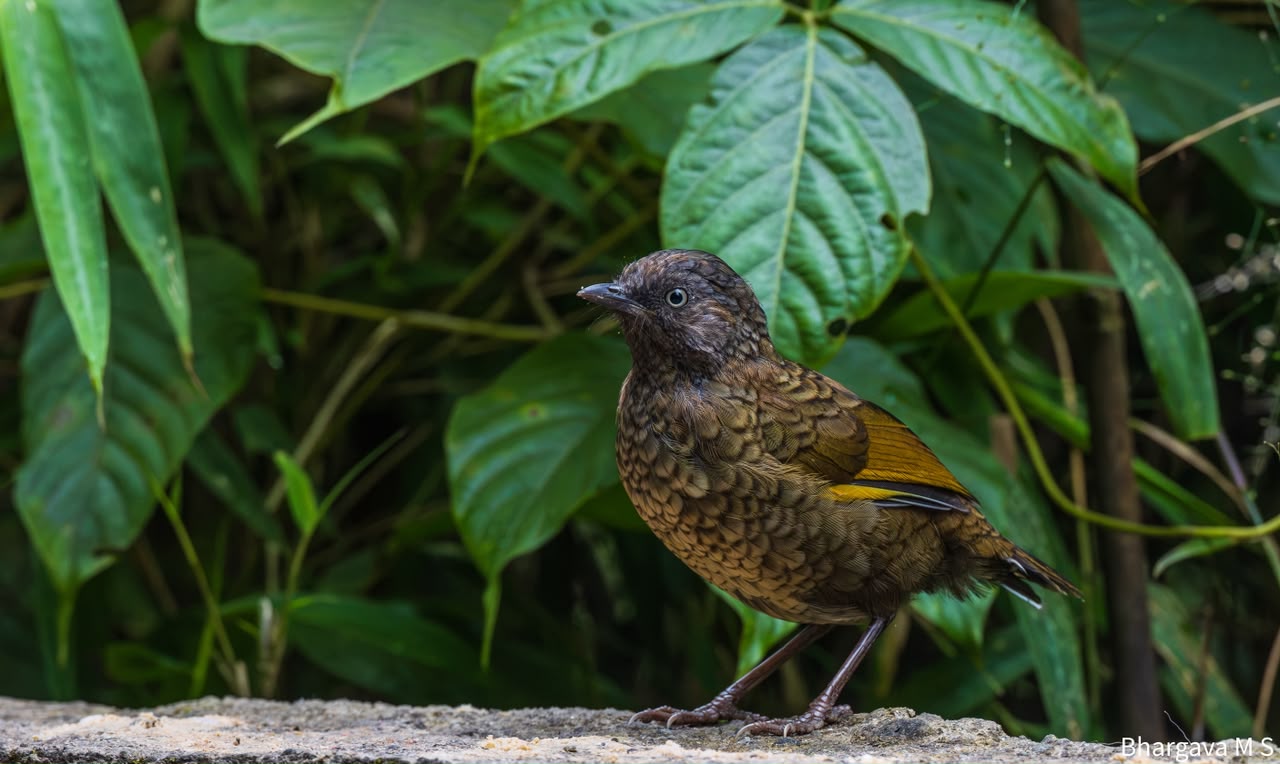
The Scaly Laughingthrush is a bird of high-altitude bamboo, olive-brown with every feather edged in black, a golden panel on the wing and a pale, staring eye. Laughingthrushes are usually heard long before they are seen. This pair was feeding on rice put out on a roadside wall, which is why they came so close; feeding spots like this are common around Darjeeling's birding sites.
Colour in the mist

Green-tailed Sunbird
Aethopyga nipalensis
Grey Bushchat, male
Saxicola ferreus
A web in the fog

In the fog every web in the village showed up, beaded with water. This one was different from a garden spider's web: instead of neat rings around the centre, the sticky thread runs in loops that turn back on themselves.
That pattern is typical of the golden orb-weavers, and in these hills most likely the Giant Wood Spider, whose large females are at their peak in October. We did not see the spider itself, so this is a likely identification, not a certain one.

The tea-garden belt
Around Dooteria Tea Garden, 3 October, early afternoon.
Below the cloud forest the slopes open into tea, with strips of forest left along the streams and ridges. By early afternoon the temperature was 18°C, with light rain on and off. Mixed flocks moved through the forest edges, and two of the trip's smaller birds came out to feed in them.

Grey-hooded Warbler
Phylloscopus xanthoschistos
White-bellied Erpornis
Erpornis zantholeucaSomewhere on the drive down we stopped by a waterfall, and simply listened.
The weather on the slope
Early October sits at the end of the monsoon in these hills. We had cloud for much of every day, and the birds were most active in the first hours of the morning.
| When and where | What we recorded |
|---|---|
| 2 Oct, afternoon, Tiger Hill | Cloud sweeping over the ridge |
| 3 Oct, dawn, Lepchajagat | Overcast, mist in the valleys, wet roads and heavy dew |
| 3 Oct, morning, cedar above Lepchajagat | Dense fog; trunks fading out within about 30 to 40 m |
| 3 Oct, 2:29 pm, near Dooteria Tea Garden | 18°C, light rain; air quality 52 on India's National AQI (“Satisfactory”) |
About these observations
All sightings were made between 2 and 4 October 2026 and submitted to eBird: 41 species of birds and two squirrels. Photos were taken through long lenses and many were photographed off camera screens, so some are record shots only. The harder identifications were checked with the guide.
| Species | Notes |
|---|---|
| Rongtong and the lower forest | |
| Great Hornbill Buceros bicornis | 1, feeding in a fruiting tree |
| Common Hill Myna Gracula religiosa | Feeding |
| Oriental Dollarbird Eurystomus orientalis | Perched on bare branch |
| Asian Barred Owlet Glaucidium cuculoides | Perched |
| Rangbull | |
| Rufous-winged Fulvetta Pseudominla castaneceps | Record photo |
| Senchal and Tiger Hill | |
| Himalayan Owl Strix nivicolum | Day roost; location withheld |
| Hill Partridge Arborophila torqueola | At least 8, at feeding log |
| Oriental Turtle Dove Streptopelia orientalis | In bamboo and at feeding log |
| Spotted Laughingthrush Ianthocincla ocellata | At feeding log, photographed |
| Grey Bushchat Saxicola ferreus | Female-type here; male at Lepchajagat |
| Lepchajagat, dawn walk, 3 October | |
| Red Crossbill Loxia curvirostra | Pair, photographed |
| Scaly Laughingthrush Trochalopteron subunicolor | Pair at a feeding spot |
| Black-throated Parrotbill Suthora nipalensis | 4, in bamboo |
| Aberrant Bush Warbler Horornis flavolivaceus | Also at Senchal |
| Green-tailed Sunbird Aethopyga nipalensis | 2 |
| Barred Cuckoo-Dove Macropygia unchall | 1 |
| Elsewhere on the circuit, 2 to 4 October | |
| Brown Parrotbill Cholornis unicolor | Photographed |
| Eurasian Hobby Falco subbuteo | Young bird, photographed |
| Collared Falconet Microhierax caerulescens | |
| Pin-tailed Green Pigeon Treron apicauda | |
| Wedge-tailed Green Pigeon Treron sphenurus | |
| Thick-billed Green Pigeon Treron curvirostra | Male, in a fruiting tree |
| Spotted Dove Spilopelia chinensis | |
| Asian Emerald Cuckoo Chrysococcyx maculatus | |
| Indian Cuckoo Cuculus micropterus | Photographed |
| Green-billed Malkoha Phaenicophaeus tristis | |
| Blue-throated Barbet Psilopogon asiaticus | |
| Lesser Yellownape Picus chlorolophus | |
| Maroon Oriole Oriolus traillii | |
| Black-hooded Oriole Oriolus xanthornus | |
| Black Drongo Dicrurus macrocercus | |
| White-bellied Erpornis Erpornis zantholeuca | Photographed, tea-garden belt |
| Grey-headed Canary-flycatcher Culicicapa ceylonensis | |
| Red-vented Bulbul Pycnonotus cafer | |
| Grey-hooded Warbler Phylloscopus xanthoschistos | Photographed, tea-garden belt |
| Grey-throated Babbler Stachyris nigriceps | Photographed |
| Silver-eared Mesia Leiothrix argentauris | |
| Chestnut-tailed Minla Actinodura strigula | |
| Black-chinned Yuhina Yuhina nigrimenta | |
| Orange-bellied Leafbird Chloropsis hardwickii | |
| Common Rosefinch Carpodacus erythrinus | |
| Mammals | |
| Black Giant Squirrel Ratufa bicolor | Rongtong, feeding in canopy |
| Orange-bellied Himalayan Squirrel Dremomys lokriah | Senchal, pair at feeding log |
Birds at the Senchal feeding log and the Lepchajagat wall were attracted with grain and rice. Altitudes are approximate and taken from published sources for each place. Names follow the eBird/Clements checklist.